
Strategic brief | 2025
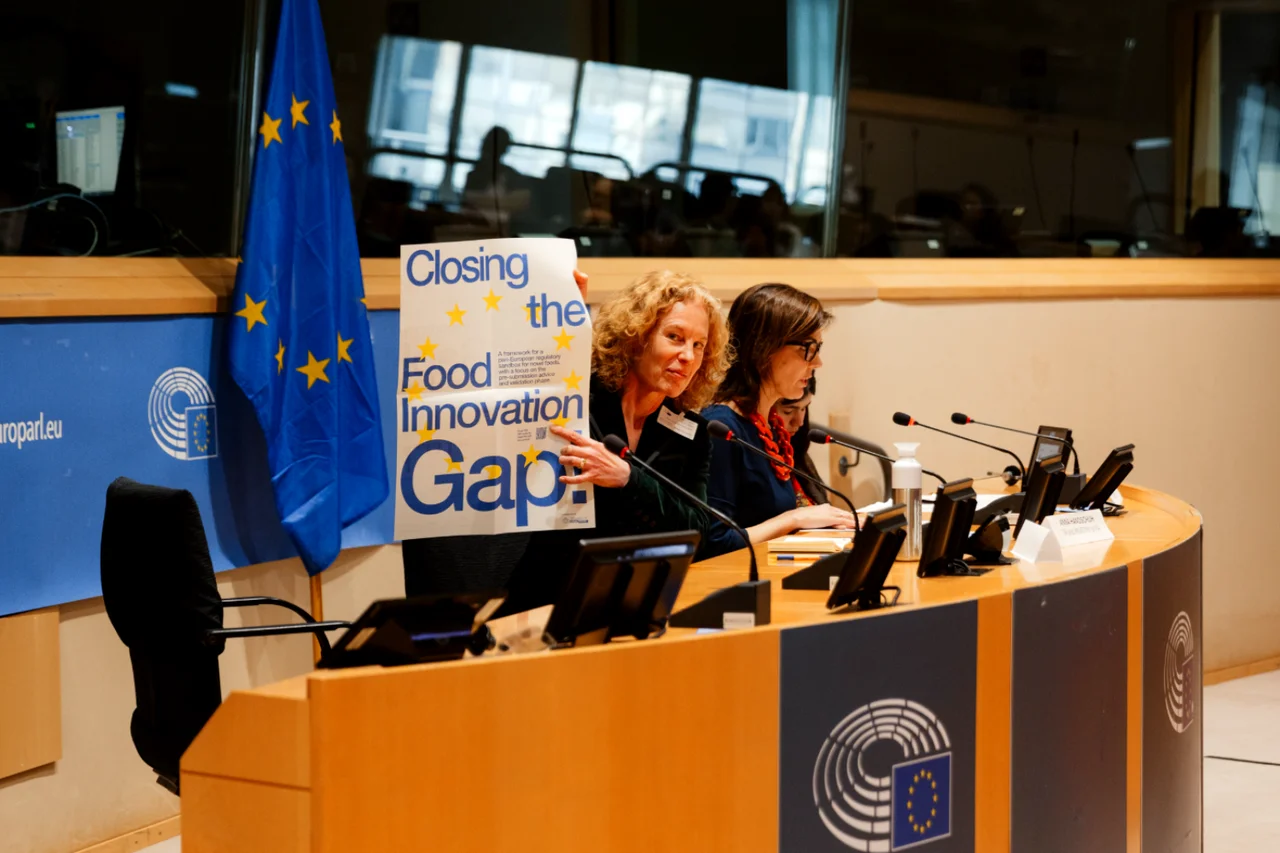
Closing the Food Innovation Gap!
A framework for a pan-European regulatory sandbox for emerging foods and complementary proteins, with a focus on pre-submission advice and the validation phase

- Authors
- Anna Handschuh, Ministry of Future Affairs Dr. Hannah Lester, Atova Regulatory Consulting Karin Verzijden, Axon Lawyers
- Format
- Strategic brief
- Published
- 2025
- Pages
- 25
www.ministryoffutureaffairs.org
| Strategic brief · Closing the Food Innovation Gap! | |||||||||||||||||||||||||||||||||||
www.ministryoffutureaffairs.org European transparency register number Stichting Ministry of Future Affairs: REG 5772533100467-78 | |||||||||||||||||||||||||||||||||||
| Publication
Executive summaryEurope’s position as a leader in biotechnology and food innovation is under threat due to regulatory barriers and inefficiencies that delay the access of complementary proteins to the EU market. This harms European competitiveness, strategic autonomy, and food security. Europe already depends on the US for the commercialisation of European innovations and on China for the supply of rare earths and other critical materials. Additionally, the EU is also increasingly dependent on food-and-feed inputs produced by biomanufacturing in China. Food-and-feed biotechnology is not science fiction – it is already a reality for Europe. Consequently, Europe is exposed to significant supply-chain dependencies which threaten the independence and security of our democracies. “Just go to the US” – when European investors recommend starting in Europe and scaling elsewhereAlthough the EU’s novel-food pre-market approval is competitive in terms of its regulated timeline and robustness, in practice the timeline is often more than twice the regulated length, making the approval process highly costly by international standards. This, along with the absence of basic favourable regulatory conditions for European startups in general, hinders investment in the EU and the commercialisation of European food innovation in its home market. Instead, an ever-increasing number of European startups are leaving the EU at an increasingly early stage, after initially finding favourable conditions for setting up in Europe. The European food-and-biotech innovation ecosystem lacks an environment that supports innovation, while international investors and other countries and regions benefit from emerging foods and related manufacturing technologies invented in Europe that are then exported. As Mario Draghi reminded us a year after his landmark report on the state of European competitiveness:
Despite Draghi’s clear diagnosis on a general level and the path set out by the Commission’s agenda, we do not see enough decisive and coordinated action taken to support emerging foods derived from food biotechnology as a strategic technology, starting with a competitive regulatory approval process. Strengthening the competitiveness of the US and China by exporting European food innovationIn order to strengthen European competitiveness, help biotech food companies to scale at home, and avoid further widening the innovation gap between breakthrough food science and regulation, this briefing proposes a framework for a pan-European regulatory sandbox for complementary proteins, such as novel foods. The framework is intended for use by those Member States that wish to accelerate safe, science-based regulatory efficiency in order to support food innovators, while maintaining high food-safety standards. Based on an analysis of regulatory key pain points from a user perspective, the authors of this brief propose a framework that responds to Draghi’s criticisms and can help to achieve the goals of the national sandbox efforts through pan-European collaboration, rather than continuing with fragmented and inefficient national efforts. Innovation-friendly regulation as strategic enabler for choosing EuropeThe main objective of the proposed framework is to improve efficiency by improving dossier quality, while also creating transparency for applicants in terms of data requirements and timelines. The framework aims to limit approval timelines to the regulated 18-month period, develop best practices, and reduce the fragmentation of sandbox approaches across Member States, thereby ensuring that European companies can choose Europe first and scale within the EU. Ultimately, the framework aims to transform regulation from a barrier into a strategic enabler, thus ensuring Europe’s food and economic security and its technological leadership. It provides a streamlined regulatory sandbox approach for novel foods for European Member States who want to champion and benefit from biotechnology and the biomanufacturing of innovative foods. Introduction
The Competitiveness Compass,3 which guides the work of the European Commission for the period 2024–2029, is based on the landmark report on the Future of European Competitiveness by Mario Draghi.4 The plan for Europe to regain its economic power and prosperity is built around three strategic pillars:
Regulatory efficiency is key to attracting investment and enabling scalingDespite these ambitious aims, Europe’s regulatory efficiency is falling behind breakthrough science in deep tech, such as in the areas of biotechnology and the biomanufacturing of emerging foods. This is already significantly harming European competitiveness and will do so for generations to come, while also exposing the European Union to new geopolitical risks, particularly with regards to food-and-feed security. In order to close the innovation gap and reduce external dependencies, Europe’s world-class biotech and food-manufacturing startups, as well as its global food manufacturers and manufacturing-technology companies, need to be able to scale biomanufacturing and commercialise in Europe first, thus allowing them to complement the existing food supply provided by Europe’s rich cultural heritage. Extra-EU dependencies in our food-and-feed supply need to be reduced by bringing the production of critical inputs back to Europe and diversifying supply. As a net-zero technology, food biomanufacturing could generate around $400 billion for food-related biotech markets by 2040.5 This would enhance the EU’s competitiveness, food autonomy, and sovereignty, while strengthening European security and preparedness. Enabling a coordinated and collaborative approach to a regulatory sandbox for novel food for Member States willing to collaborate would contribute to a safe and more efficient pre-market approval process. Approving emerging foods more efficiently is essential if Europe is to scale up, close the innovation gap, and reduce its external geopolitical dependencies. However, while the strategic importance of an efficient regulatory pathway is widely recognised in the context of medical biotechnology, this is not yet the case for food biotechnology, including the support of those emerging foods in defence or dual-use contexts, in the EU. Purpose of this strategic brief: understand the barriers to regulatory efficiency and showcase solutions
Against this background, the purpose of this strategic brief is to provide a solution-oriented approach to building an innovation-friendly regulatory pathway for emerging foods. These new foods and their manufacturing technologies are a means to an end, contributing, alongside other food sources, to securing Europe’s strategic autonomy, decarbonisation, and food and economic security. While the authors of this brief fully support the EU’s high food-safety standards, we also believe in our capability as Europeans to make our regulatory systems and the regulatory approval process work within the regulated timeline, thereby ensuring that the EU does not further slip into extra-EU dependencies for our food-and-feed production. In this sense, this brief should be understood as a contribution to the objectives set out for the mandate based on Mario Draghi’s findings. Europe should not see its own food innovation as antagonistic to its traditional food heritage but as essential to strategic autonomy and sovereignty, especially at a time when China is striving to maximise its geopolitical influence and technological dominance and is investing heavily in food-and-feed biomanufacturing. As a leader in biotechnology, China will be able to exert the same kind of control over food and feed derived from biomanufacturing that it currently does over rare earths and critical materials, thereby undermining European food and economic security. From lab to fab? The cost of delaying regulatory efficiency
The true cost of regulatory barriers is a further loss of competitiveness and strategic autonomy, as investment in Europe is deterred. Lost investor confidence has resulted in European capital building abroadInvestor confidence in the European Union’s novel-foods authorisation process – particularly its time-to-market and predictability – has significantly eroded. As a result, EU-based food-tech investors recommend that companies launch in the United States. However, to safeguard the security and quality of our food supply and uphold Europe’s high standards, European companies need to have reliable and effective access to the Single Market. Regulatory uncertainty, amplified by the absence of a unified market for capital, has led to the EU being deprioritised as an investment destination and undermined the attractiveness of the Single Market. Consequently, European capital that would otherwise have been invested in the EU is ultimately diverted instead to the US and Asian markets, further strengthening the technological leadership and competitiveness of the US and China. Europe’s choice: enable biotech and emerging foods at home or let China take controlThe regulation of novel foods is not an end in itself – it is a means to securing Europe’s food sovereignty and food security. Europe is facing a choice: enable and control food biomanufacturing at home or get controlled by it from abroad. Europe’s livestock sector already depends on China for critical feed inputs such as essential amino acids and vitamins. Industry data indicates that most of these inputs are imported from China, exposing a key structural vulnerability in our food system and weakening Europe’s sovereignty. A recent report from the European Feed Manufacturers Federation highlighted the fact that China produces, by volume, between 65% and 90% of precision-fermentation-derived amino acids and between 50% and 100% of the vitamins currently imported into the EU for animal consumption.6 Moreover, China is investing heavily in food biomanufacturing due to its strategic significance. This is evidenced by the number of generally recognized as safe (GRAS) notifications made to the United States Food and Drug Administration (FDA) by Chinese companies. Recently, 49% of the GRAS notices on the first page of the inventory were submitted by Chinese companies, all for innovative ingredients derived from fermentation or precision fermentation.7 China is clearly aware that gaining a competitive advantage in terms of food security through food biomanufacturing, as part of a broader agricultural-processing and food-manufacturing strategy with biotechnology as a key component, will further consolidate the country’s position of leadership at the intersection of geopolitics and technology.8
Sources: Advanced Biotech for Sustainability (2025), market estimate; FEFAC (2025), EU vulnerability for the sourcing of essential nutrients; GRAS inventory analysis by Atova Regulatory Consulting, 3 October 2025. Pan-European regulatory sandboxes: key to European competitiveness and strategic autonomyRegulatory sandboxes provide an effective solution that can streamline approval processes, reduce costs and workloads, shorten timelines, and alleviate administrative burdens, all while maintaining stringent safety standards. Regulatory sandboxes can facilitate the implementation of evidence-based adjustments to regulation, ensuring that oversight is aligned with technological advancements. They can allow for the use of temporary, flexible frameworks for rapid experimentation and take the principle of adaptive regulation into account, helping to ensure that innovation and oversight evolve in tandem. When applied to deep technologies such as biotechnology and biomanufacturing, regulatory sandboxes can provide a safe, step-by-step testing environment and ensure that the regulatory environment keeps pace with scientific progress. In this way, sandboxes can be powerful and efficient mechanisms for supporting competitiveness and enhancing strategic autonomy. The enabling of cross-border regulatory sandboxes is vital if Europe wants to benefit from its R&D investments in biotech instead of exporting their economic potential and losing on another battlefield, this time the ‘biotech battlefield’ where the Chinese “strategy is to use its growing biotech dominance as economic and geopolitical leverage around the world”.9 Regulatory sandboxes for novel foods in the United Kingdom and EU Member States
In addition to the United Kingdom, which is well advanced with its cell-cultivated-product regulatory sandbox and has just launched a regulatory innovation research programme for precision fermentation, several EU Member States, including Denmark, Spain, the Netherlands, and Germany, are exploring or preparing various experimentation spaces for novel foods.10 The majority of the cell-cultivated regulatory sandbox participants in the UK are novel-food companies located in the EU. To date, only two of the participating companies have submitted novel-food applications in the EU. As the example from the UK shows, countries that develop optimised regulatory processes and support experimentation spaces such as regulatory sandboxes can be expected to attract innovators and investors, thereby benefiting in terms of both competitiveness and access to strategic technologies. In the global biotech race, Europe needs to act more in line with the objectives set out in the Competitiveness Compass and transform the novel-food regulation from a barrier into a strategic enabler of biotech leadership, thereby avoiding further loss of competitiveness and autonomy and preventing Europe from slipping into greater dependency on China and the US. Beyond novel foods – a new European narrative: emerging foods and new, complementary protein production for strategic autonomyIn recent years, the polarisation around the term ‘alternative proteins’ has had a negative impact on the novel-food sector. According to our research, the term ‘alternative protein’ has its roots in earlier usage in animal-nutrition literature.11 It is imperative that the EU does not become further embroiled in a proxy war over ‘alternative proteins’ and ‘non-natural foods’, which pits the farming community against new foods. This is counterproductive and undermines Europe’s preparedness, competitiveness, and security. Food biotechnology as a strategic asset in a new geopolitical landscapeIt is hoped that this briefing will contribute to the de-polarisation of emerging foods and return to a discussion in which the geopolitical and technological importance of food biomanufacturing as a provider of complementary proteins is recognised through regulatory efficiency. Europe cannot afford further polarisation that discredits its own scientific achievements in strategic biotechnologies. Many biomanufacturing technologies for emerging foods have been developed in Europe and received early-stage funding from the EU, only to be scaled up and commercialised outside Europe due to the significant time it takes to bring them to market, compared to other global markets. It is vital that we close the European innovation gap by establishing optimised regulatory pathways for strategic technologies, including food biomanufacturing and biotechnology. Objectives of the strategic briefing: an innovation-friendly framework for a pan-European regulatory sandboxIn recent years, regulatory sandboxes have attracted considerable attention as a means of exploring more flexible approaches to governing emerging technologies. However, much of the debate has focused on the limitations of policy and regulatory innovation, rather than on potential solutions. This might also explain why several Member States have adopted individual sandbox approaches, with widely varying ambitions and levels of depth. In order to design a regulatory sandbox that is in line with harmonised EU food law, it’s crucial that Member States recognise the importance of regulatory sandboxes and adopt a coordinated approach to unlocking their potential through a joint regulatory learning process. The purpose of this strategic brief is to inspire an efficient and collaborative pan-European approach to a novel-foods sandbox. Rather than presenting another report, this brief offers an action-oriented framework for a Europe-wide novel-food sandbox, with the following objectives:
01. Regulatory sandboxes as spaces for controlled experimentation01.01. Regulatory sandboxes in an EU innovation policy contextA sandbox is a controlled, time-bound regulatory environment in which innovative products, services, and business models can be tested under supervision, often with temporary exemptions from standard rules. The OECD report, The Role of Regulatory Sandboxes in Promoting Flexibility and Innovation in the Digital Age (2020), views regulatory sandboxes as a key instrument for regulatory innovation:
New EU innovation policy on regulatory sandboxesIn 2023, the European Commission referred to regulatory sandboxes as “structured frameworks for cooperation with competent authorities that allow innovators to develop and test new ideas, products, business models and services in a controlled real-world environment under the supervision of a competent authority”.13 Furthermore, regulatory sandboxes can relax or suspend rules under certain conditions and under the supervision of the relevant authorities. These authorities can also provide the necessary legal guidance applicable to products tested in the sandbox. However, it’s important to note that regulatory sandboxes are always limited in terms of time and scope. They are structured spaces for experimentation, based on transparent frameworks and operating under strict guidelines. Regulatory sandboxes based on a pan-European framework can balance stability, integrity, and consumer protection with accelerated innovation, as already demonstrated by the European Blockchain Regulatory Sandbox.14 Guidelines for sandboxes in general and for sustainable biotechnology, more specifically, as expected from the Innovation Act and the Biotech Act, would help to provide regulatory clarity, thereby supporting innovation and efficiency. 01.02. Applying sandboxes and regulatory learning formats to the current regulatory framework for emerging foodsProf. Linda Nielsen describes different types of sandboxes in her 2024 report Biosolutions, regulatory sandboxes as a tool for breaking down regulatory barriers, commissioned by the Novo Nordisk Foundation.15 Since the definition used for “biosolutions” includes novel foods, this categorisation is a useful tool for improving the regulatory efficiency of the food-safety evaluation process in the EU. According to Nielsen, regulatory sandboxes are typically divided into three generations: Gen1 being the classic sandbox that can be applied within existing frameworks, Gen2 offering a sandbox that operates with regulatory exemptions, and Gen3 being a sandbox based on new regulations. Gen1: classic sandboxFirst-generation sandboxes are regulatory tools that allow businesses to test and experiment with new and innovative products, services, or businesses under the supervision of a regulator for a limited period, while operating within existing regulations. No changes to the law are required in order to establish regulatory sandboxes, since they involve the use of the general supervisory powers available to the competent authorities. The primary effects of a classic sandbox are the new knowledge/evidence from supervised testing, the legal clarity obtained, and mutual learning between innovators and regulators. Legal certainty can be obtained in areas where it might be difficult to decide which regulations – if any – are relevant to the products, methods, etc. being tested. However, the restriction of keeping within current regulations limits the scope and tools of the classic sandbox, which has led to the development of Gen2 and Gen3 regulatory sandboxes. Application in the novel-food sector: The Danish Food Administration has facilitated a Forum for Future Ingredients, in which industry representatives, ingredient companies, and research institutions discuss topics relevant to the ingredient industry. The Ministry of Food, Agriculture and Fisheries of Denmark initiated The Ingredients Strategy with the aim of creating better framework conditions for the ingredients industry, including identifying regulatory barriers to sustainable innovation in the sector. The ingredients covered by the strategy include additives, enzymes, and flavourings, as well as new raw materials, including protein sources and side streams from food-and-feed production.16 Gen2: sandbox with exemptionsSecond-generation sandboxes provide the same structure and benefits as Gen1 sandboxes while allowing for exemptions from current regulations, making them potentially far more powerful if used proactively. In practice, however, the primary focus seems to be on exemptions from national regulation rather than from EU-wide regulation, which limits their potential, given the legacy and scope of binding EU regulations. The challenge regarding Gen2 sandboxes is primarily the legal basis, and it is not always clear if exemptions can go beyond national regulations and include EU regulations. Application in the novel-food sector: Gen2 sandboxes have limited application in the food sector due to the predominance of binding EU regulations. Nonetheless, one positive example is the Dutch Code of Practice, which allows for pre-market tastings of cell-cultured foods in a controlled environment. Provided that the tasting protocol is positively evaluated by an expert committee and is adhered to by the company, no food-safety enforcement measures by the Dutch Food Safety Authority will take place. Gen3: sandboxes based on EU regulation17Gen3 sandboxes are similar to Gen1 and Gen2 sandboxes but operate under a specific legal basis in terms of EU regulation. This version of the sandbox is highly novel, with illustrative examples being the EU AI Act on artificial intelligence, the EU DLT Act on blockchain, the Net-Zero Industry Act, and a proposal on medicinal products. The Net-Zero Industry Act (Regulation (EU) 2024/1735 or NZIA)18 and food applications: While the NZIA primarily regulates strategic net-zero technologies, the provisions for regulatory sandboxes also include “other innovative technologies”, including biosolutions. According to Nielsen, “biosolutions” are understood as goods and services derived from combining biology and technology aimed at accelerating the green transition. Regulatory sandboxes for food biotechnologies may be established in these new areas, with the regulation creating a framework for their content. This clearly follows from Articles 2, 33, and 34 of the NZIA. The NZIA enables the competent authorities in Member States to set up a regulatory sandbox and to make derogations from national regulations, but limits their ability to grant derogations from current EU regulations. This may narrow the practical influence of the NZIA, since most biosolution regulations involve binding EU Regulations that cover pesticides, novel foods, additives, genetically modified organisms, and new genomic technologies. Application in the novel-food sector: Precision fermentation could be a relevant candidate for a regulatory sandbox, since there are currently several barriers to gaining the required market approval, including the difficulty of determining which regulations apply (e.g., GM food vs novel food), the difficulty of understanding the data requirements and procedure in practice, and the fact that applications are time-consuming, complex, and costly, and it may take several years to obtain approval. 02. State of play – the novel-foods approval process in the EU02.01. Legal basis: the novel-food framework in the EURegulation (EU) No. 2015/2283 (“EU Novel Food Regulation”)19 provides a robust framework for the pre-market safety evaluation and authorisation of novel foods. Together with the other applicable food-safety and hygiene regulations in the EU, this framework ensures a high level of consumer protection. Since 2018, the year in which the current EU novel-food regulation became applicable, more than 100 novel foods have been approved for use. While the EU novel-food regulatory framework is often seen as a barrier to market entry, it does offer some unique benefits:
New technologies and innovations in food manufacturing should be encouraged, since they hold great potential to decarbonise the food system, enhance food security, and bring benefits to new consumer groups – so long as the currently high level of consumer protection is ensured. An overview of the novel-food approval process is provided in Figure 1. The approval process can be broken down into four distinct phases:
Fig 01 An overview of the novel-food approval process 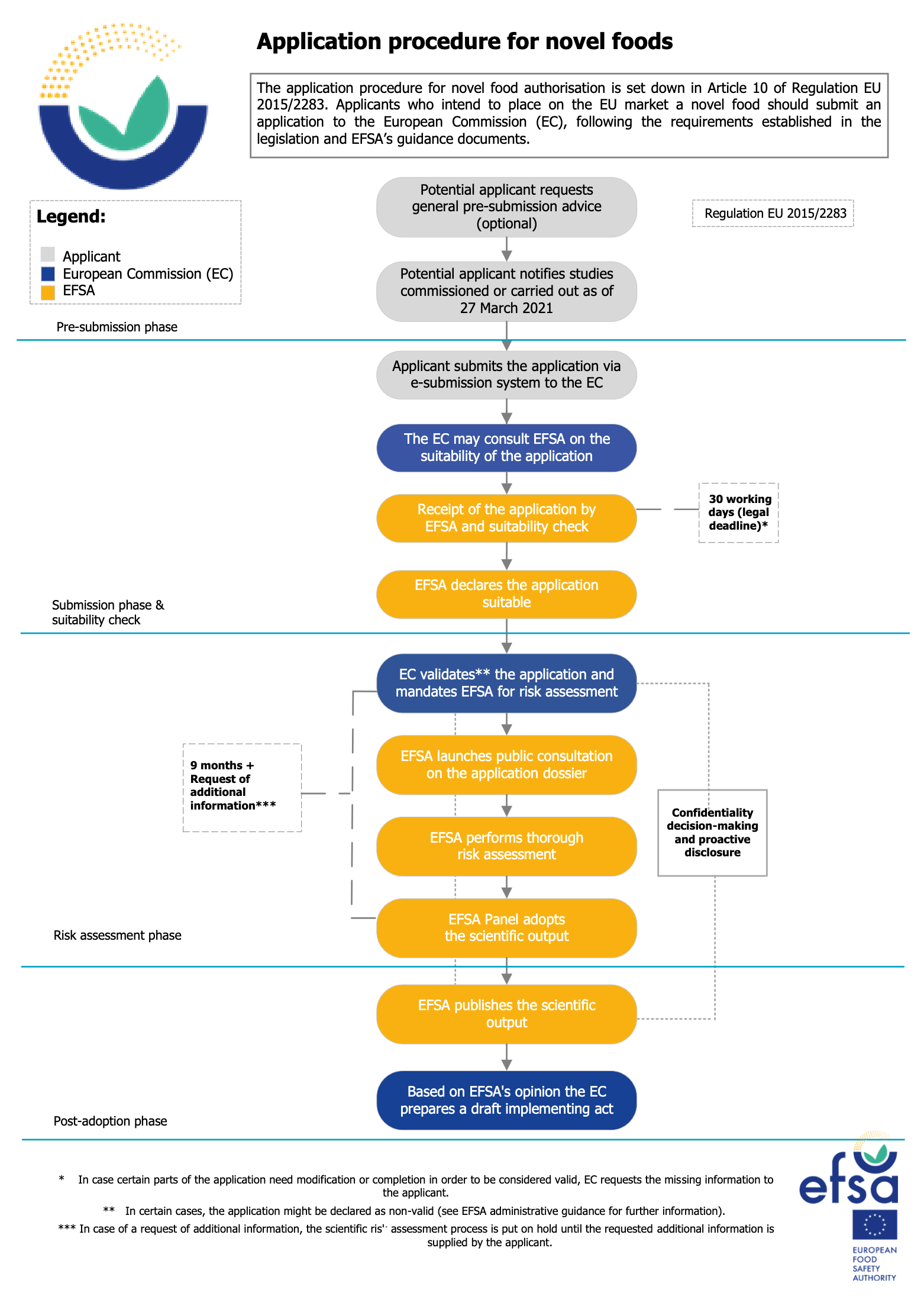 02.02. International comparison of market-approval processesWhen comparing the EU novel-food approval process to other regional jurisdictions, the regulated timeline is comparable. However, in practice, when it comes to actual timelines and hidden costs:
Market approval, by jurisdiction
Fig 02 Market approval in the EU, US, Singapore and Australia/New Zealand – months and EUR Actual timeline
Timeline uncertainty
Study cost at submission
Cost uncertainty
02.03. The EU novel-foods approval process: regulatory pain points and recommendations for an innovation-friendly user journeyThe overview below highlights the main challenges faced by applicants, along with specific examples and our recommendations on how to improve efficiency and streamline the approval process. The recommendations are linked to the concrete work packages presented under Section 3.2 of the framework. We recognise that the loss of efficiency is not only related to the risk-assessment and risk-management phases, but that applicants need to prepare good quality, compliant dossiers to start with. As such, our recommendations are also aimed at improving dossier quality.
|